


Investment Banking Target Schools List: UK & US Edition (2025–2026)

By City Investment Training

Studying at a target or semi-target matters in investment banking because it puts you on the main recruitment pipeline. Banks hire efficiently, and these universities offer built-in access: campus presentations, closed networking events, strong alumni networks, and earlier visibility for spring weeks and summer internships. Recruiters also trust the “signal” of these schools, so your CV is more likely to be read and taken seriously, which usually means more interviews with less friction.
But it’s not a golden ticket. A target school gives access, not an offer. You still need technical skills, sharp interview performance, and consistent networking to convert opportunities. Semi-targets can be just as viable if you’re proactive, and non-target students can still break in by stacking proof of skills and building relationships. Pedigree opens doors, but preparation decides who gets through them.
This guide shows the UK + US target and semi-target shortlist most relevant to investment banking recruiting, plus what to do if you’re outside Tier 1.
Quick Answer: What is a “Target School”?
A target school is a university where investment banks consistently recruit through a mix of:
On-campus (or society-led) events
Dense alumni networks in front-office roles
More consistent interview pipelines
Target = easier access to interviews.
A semi-target places students every year too, but you generally need to be more proactive with:
Networking
Early experience
Technical preparation
Semi-target = access exists, but you must push harder.
Non-target = still possible, but you must create access with networking + proof of skills.
What are the target schools for Goldman Sachs?
Goldman Sachs does not publish an official “target school list.” In reality:
Certain universities appear more often in pipelines (alumni density + recruiting infrastructure)
Goldman also runs structured early insight routes and multi-stage screening that can open doors beyond traditional feeders
Translation: the school can help you get seen. Your skills determine whether you get chosen.
Tier 1 (Target) vs Tier 2 (Semi-Target): UK & US (2025–2026)
Not official. “Target” varies by bank, office, and division (IBD vs S&T vs ER). Use this as a practical starting point, not scripture.
United States
Tier 1 (Targets / “Super Targets”)
UPenn (Wharton)
Harvard
Columbia
Princeton
Yale
NYU (Stern)
University of Chicago
Duke
Stanford
MIT
Tier 2 (Semi-Targets)
Michigan (Ross)
Virginia (McIntire)
Georgetown
Cornell
Northwestern
Notre Dame
UC Berkeley (Haas)
UNC Chapel Hill
UT Austin (McCombs)
Vanderbilt
United Kingdom
Tier 1 (Targets)
Oxford
Cambridge
LSE
Imperial
UCL
Warwick
Tier 2 (Semi-Targets)
Durham University
University of Bristol
University of Nottingham
University of Bath
King’s College London (KCL)
University of Edinburgh
University of St Andrews
University of Exeter
Additional schools sometimes viewed as semi-targets (lower consensus):
University of Manchester
University of Birmingham
University of Leeds
How to use this list (so it actually helps)
If you’re Tier 1: Exploit access. Do every event, get interview reps early, and don’t assume brand = offer.
If you’re Tier 2: Start in first term. Top grades + early experience + networking cadence wins.
If you’re non-target: Build a “portable brand”: proof-of-work, a repeatable outreach system, and interview-level technicals.
People also ask
Are target schools the same for every bank? No.
Targets vary by bank, office (London vs New York), and division (IBD vs S&T vs ER).
Is a Master’s degree or MBA required for investment banking?
No for most undergraduate pipelines. It can help later, but it isn’t required to get a summer analyst role.
Do banks care more about university name or experience?
The name can help you get seen. Experience and interview performance usually decide the offer.
When should I start preparing for investment banking?
Ideally first year (UK) or sophomore year (US). Earlier if you’re at a semi-target or non-target.
FAQ
Do banks publish an official target-school list?
No. Lists are unofficial and vary by bank, office, and division.
Is Goldman Sachs school-agnostic now?
Goldman has expanded structured screening and early access routes, but feeder patterns still exist.
Can you get into IB from a non-target?
Yes. The path is just more engineered: networking + relevant experience + technical excellence.
How City Investment Training helps semi-target and non-target students
If you’re not at a Tier 1 target, you need signal (proof you can do the job) and distribution (ways to get seen).
City Investment Training helps you build both:
Technical confidence that shows up in interviews: accounting, valuation, DCF, M&A, LBO, plus how to explain assumptions cleanly
Mock interviews that convert: repetition + feedback until you sound like an analyst, not a student
A networking system you can run weekly: outreach scripts, alumni targeting, follow-up frameworks, referral conversion
Proof-of-work assets: pitch decks, deal write-ups, modelling outputs you can reference in emails and interviews
Bottom line: Target schools help you get seen.
👉 APPLY NOW FOR OUR 8-WEEK INVESTMENT BANKING INTERNSHIP TRAINING PROGRAM
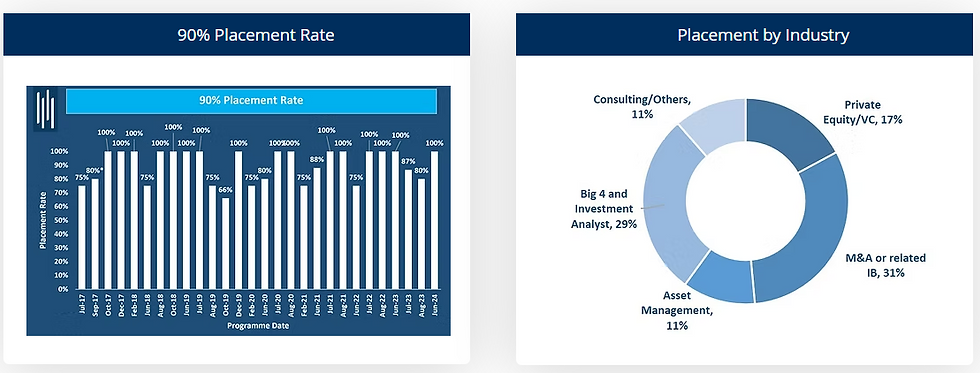
We have a 90% placement rate on our 8-week program with past students securing jobs at marquee banks and PE companies such as Goldman Sachs, Morgan Stanley, JP Morgan, UBS, KKR, Bain Capital amongst many others.
Click here to find out more on our 8-week program: https://www.cityinvestmenttraining.com/full-time-analyst


I found this content particularly interesting and well documented. The text manages to cover the subject without being superficial. I added this page to my bookmarks for future reference. It does not often happen to find such a balanced text on this topic.
The text is well structured and addresses the topic with the right depth. Many of the points covered made me think about the topic in a new way. I found it useful to reread some parts after the first complete reading. It is not easy to find articles that treat this subject with this clarity.
Relationships built (ไซด์ไลน์) online depend on communication that is thoughtful, steady, and sincere. Whether the connection is romantic, friendly, or supportive, digital interaction helps people stay close across long distances. The ability to message anytime makes it easier to share feelings, solve problems, and keep a relationship active. Online communication also gives people time to understand each other more deeply before meeting in person. Still, trust and respect remain essential. Without them, the relationship may feel weak or uncertain. With them, however, online communication can become a powerful way to create connection in the modern world.
hi
Investment banking target schools useful. As a PhD student who works part-time at Last-Minute Assignments, I've seen how school prestige matters. I was so focused that I'd search for assignment editing service UK just to polish my application. Your post is a definitive list. Thank you for that. Rankings, tiers, strategy. Grateful for the resource. Keep aiming high. Seriously, my career path is sharper. Here's to target schools. Thanks for the list. Cheers.